Designating Yesterday's Distress: How the Proposed EB-5 Rule Redraws the High-Unemployment TEA Map
Author: Kevin Wright, AIIC
Date: September 2026
DHS's proposed EB-5 rule (91 FR 40676, July 2, 2026) would end the "census-share" methodology that USCIS has accepted since the Reform and Integrity Act for showing that a project site sits in a high-unemployment area. Going forward, filers would be expected to rely on the American Community Survey 5-year estimates alone. The preamble frames this as a statistical-validity fix. DHS also admits it could not quantify how many projects or areas the change would affect (91 FR 40755).
So we quantified it. We tested every one of the 85,382 census tracts in the 50 states, D.C., and Puerto Rico — alone and combined with directly adjacent tracts under the statute's 150% weighted-average test — under today's rules and under the proposed rule. The answer is not what most people in the industry expect, and it is worse than a simple "fewer TEAs" headline.
The short version
The proposal is a one-way contraction. Nothing is gained anywhere, and 6,030 tracts lose. Those 6,030 tracts are not the affluent enclaves the TEA reforms were written to exclude — they are the places whose economies have deteriorated in the last year or two. What survives skews toward areas whose five-year averages are still propped up by the 2020–2021 pandemic shock, including hundreds of tracts with six-figure median incomes and unemployment below the national average. The rule would aim the $800,000 incentive at where distress *was* and deny it to where distress *is*.
Why the right comparison is "today vs. proposed," not "method vs. method"
It is tempting to compare census-share against ACS head to head. That framing is wrong, and it was the first thing we had to fix in our own analysis. Today a filer may use *either* data source, so the universe of qualifying sites is the union of both methods. The proposal simply removes one pathway. The only correct measure is: today's dual-source map versus the proposed ACS-only map.
Measure | Today (either source) | Proposed (ACS only) | Change |
Tracts that can anchor a qualifying HUA (alone or with adjacent tracts) | 44,959 | 38,929 | −6,030 |
Share of all U.S. tracts | 52.7% | 45.6% | −7.1 pts |
Tracts qualifying on the single tract alone | 21,575 | 18,665 | −2,910 |
Labor force in qualifying tracts | 81.5 million | 69.8 million | −11.7 million |
Method by method, the two data sources are almost the same size — 38,721 tracts qualify via census-share, 38,929 via ACS. But they overlap on only 32,691 tracts, because they measure different periods. The 6,030 census-share-only tracts are the entire effect of the rule. The 6,238 tracts that qualify only on ACS data already qualify today and are simply unaffected.
That also settles a myth: census-share does not inflate the TEA universe. Standing alone it qualifies slightly *fewer* tracts than ACS does. What it contributes is different tracts — the currently distressed ones.
Figure 1. HU-TEA project-site eligibility by census tract under today's dual-source regime vs. the proposed ACS-only standard. Orange tracts are the proposal's entire effect
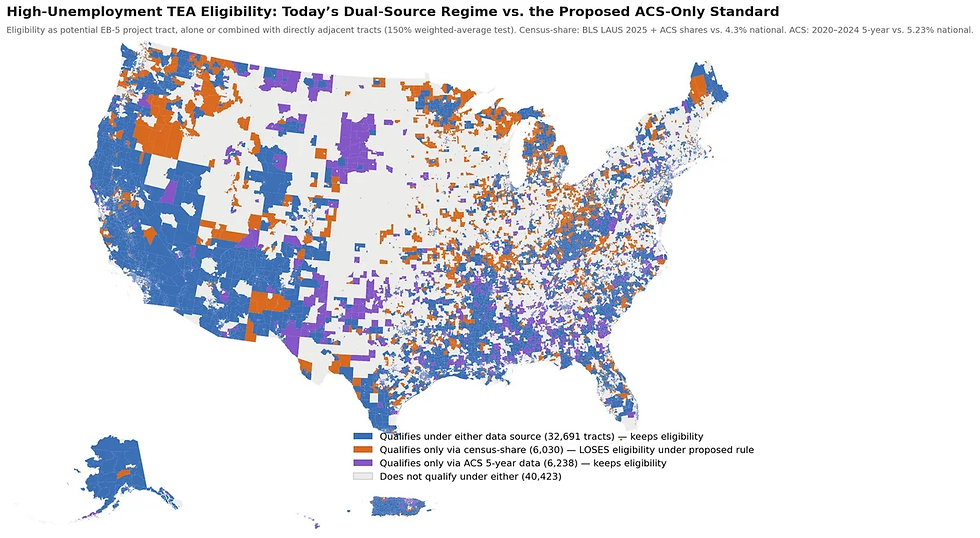
The tracts being eliminated are the ones that are distressed now
The eliminated tracts qualify only on current data because their distress is recent. Their median 2025 unemployment rate (census-share) is 4.8%, against a 4.4% median five-year ACS rate — economies that softened in 2024–2025, which a 2020–2024 average cannot yet see.
The surviving ACS-only tracts show the mirror image: a median five-year rate of 5.7% against a median current rate of 3.6%. About one in five of them sits in eleven large urban counties — the New York City boroughs, Miami-Dade, Cook, Los Angeles, Harris, San Juan, Honolulu — whose five-year data still carry the pandemic shock.
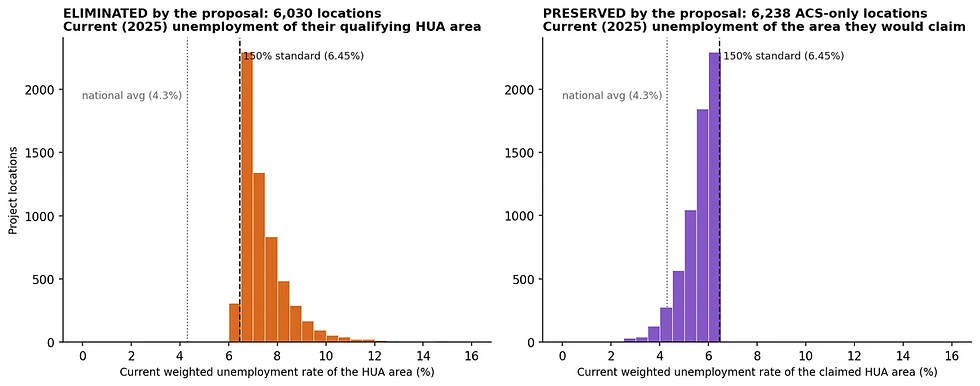
Put in the statute's own terms: every one of the 6,030 eliminated locations can show a qualifying area at or above the 150% standard on current data (median claimed-area rate 7.1%). Every one of the 6,238 ACS-only locations the proposal preserves falls *below* the current-conditions equivalent of that standard (median 5.8%), and 64% of those project tracts have current unemployment below even the 4.3% national average.
Figure 2. The trade in current-conditions terms: every eliminated location is distressed today (left); every ACS-only location the proposal preserves is not (right).
Where the losses fall
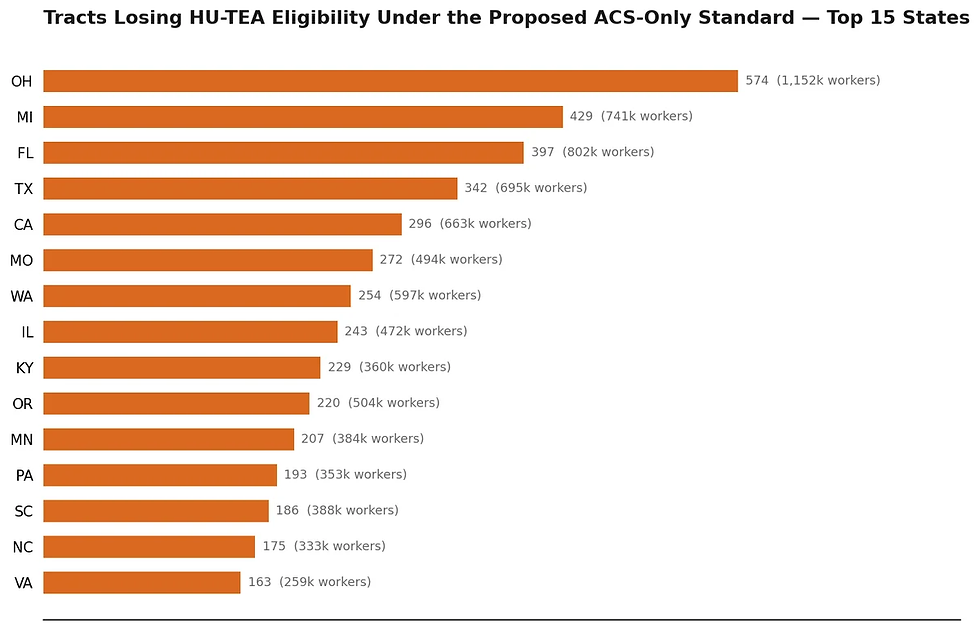
Losses concentrate in states whose labor markets cooled in 2024–2025: Ohio (574 tracts), Michigan (429), Florida (397), Texas (342), California (296), Missouri (272), Washington (254), Illinois (243), Kentucky (229), and Oregon (220). The hardest-hit counties include King and Snohomish (Seattle), Pierce (Tacoma), Washington and Clackamas (Portland), Lee, Sarasota and Polk (Florida's Gulf coast), Middlesex (Boston), Kent (Grand Rapids), Monterey, Franklin (Columbus), and the District of Columbia.
Figure 3. Tracts losing HU-TEA eligibility under the proposed ACS-only standard, 15 most-affected states.
Even surviving sites lose flexibility
Counting a location as "qualifying" whenever at least one adjacent-tract combination works understates the damage. Sponsors rely on the range of permissible configurations — to match the area to where the enterprise actually operates, to handle a multi-tract site, or to survive a data revision at the two-year renewal.
So we enumerated every possible adjacent-tract configuration for every project tract in the country — 69.8 million combinations — and tested each under both regimes. Of the 10.5 million configurations that qualify today, 1.17 million (11.1%) would be eliminated. Beyond the 6,030 locations that lose everything, another 4,842 surviving locations lose more than half of their workable configurations, and 2,192 lose more than three-quarters. In total, 10,872 potential project locations — nearly a quarter of today's qualifying map — either lose eligibility outright or lose most of their options.
Figure 4. Share of each location's qualifying adjacent-tract configurations eliminated by the proposed standard.

This is the opposite of what Congress asked for
The RIA's TEA reforms have one stated purpose: make sure the discounted investment level steers capital into places that need it, and stop it from subsidizing development in prosperous places that don't. Senators Grassley and Leahy, the RIA's authors, said so in their March 10, 2022 colloquy — and they addressed the exact question the data standard decides, which time period counts:
"It is also our expectation that 'high unemployment' TEA designations will be reserved for census tracts that have experienced persistently high unemployment for a number of years and not because of temporary anomalous circumstances such as local unemployment caused by the COVID-19 pandemic." — 168 Cong. Rec. S1105
Exclusive reliance on the 2020–2024 ACS window does precisely what the authors disclaimed. The 2020–2021 pandemic shock becomes the deciding factor for every marginal tract.
It also revives affluent-area capture in a new form. The RIA's adjacency limits ended the 190-tract chains that let Hudson Yards qualify off a public-housing project in upper Manhattan. The proposed data standard reopens the same outcome through *time* rather than geography. Under the proposed rule, 1,334 project tracts with six-figure median household incomes (382 above $150,000) qualify only via the ACS pathway — prosperous tracts, fully recovered today, whose eligibility rides on pandemic-era rates. A few of the anchors the rule would preserve and current data would deny:
Project tract | County | Median HH income | Current (2025) unemployment | ACS 2020–24 unemployment |
06041118100 | Marin County, CA | $250,000+ | 0.5% | 0.7% |
06075021100 | San Francisco County, CA | $250,000+ | 2.1% | 3.1% |
09190010201 | Western Connecticut, CT | $250,000+ | 0.6% | 0.9% |
36119005400 | Westchester County, NY | $250,000+ | 3.3% | 5.9% |
51059492201 | Fairfax County, VA | $250,000+ | 4.2% | 5.7% |
A tract with a quarter-million-dollar median income and half-a-percent unemployment holding the same TEA status as the South Side of Chicago is Senator Leahy's "Beverly Hills can be considered just as distressed as Detroit" — produced this time not by map-drawing, but by the data standard itself.
DHS's own words box it in. The 2019 Modernization Rule said the TEA incentive must not reach "gerrymandered areas where high unemployment may not truly exist" (84 FR 35779). The 2026 preamble twice describes the program's object as "areas of true need" (91 FR 40695) — and then its high-unemployment section contains no purpose analysis at all. The words "gerrymander," "distressed," and "congressional intent" appear nowhere in the NPRM.
An honest accounting
The data do not show that the proposed map is predominantly affluent or a wholesale return to Hudson Yards-era abuse. The proposed map's median tract household income ($64,000) is below the national median, and five of every six proposed-map locations claim areas that are currently distressed. The defect is at the margin — but the margin is large (12,268 locations, nearly 24 million workers), it runs systematically in one direction (preserve recovered areas, exclude newly distressed ones), and it carries the affluent-anchor tail above.
Nor does DHS's stated rationale answer the objection. The preamble rejects census-share on statistical-validity grounds, but precision and timeframe are different questions. A statistically pristine measurement of the wrong period does not identify areas of true need. And DHS's own proposed 204.402(b)(4) accepts state workforce-agency estimates when federal data are unavailable — conceding that ACS exclusivity is not itself the point.
What a final rule should do
A final rule that permits current-period unemployment data — the census-share methodology, or state workforce-agency current estimates under 204.402(b)(4) — whether as an alternative basis or as a required corroboration of ACS-based claims, would align the designation process with the RIA's purposes without expanding the TEA footprint by a single tract. Only current-period data can distinguish persistent distress from a pandemic spike. Retaining it is not leniency; it is the only way the designation process can see whether distress is real and ongoing.
---
*Methodology in brief.* ACS-only standard: tract civilian labor force and unemployment from ACS 2020–2024 5-year estimates (Table B23025); national benchmark 5.23%, giving a 150% threshold of 7.85%. Census-share: BLS LAUS 2025 county annual averages allocated to tracts by ACS shares; national benchmark the CPS 2025 annual average of 4.3% (11-month average excluding October 2025 due to the federal shutdown), giving a threshold of 6.45%. Adjacency from the Census Bureau's cb_2024_us_tract_500k boundary file using queen contiguity. Tract values were cross-checked against the Census Reporter API; the LAUS aggregate reproduces the national 2025 rate (4.29% vs. 4.28% CPS). Income dimension from ACS Table B19013. Full reports: *Redrawing the High-Unemployment TEA Map* (July 17, 2026) and *Designating Yesterday's Distress* (September 1, 2026), AIIC. *Sources:* 91 FR 40675 (July 2, 2026), Docket USCIS-2026-0100; 84 FR 35750 (July 24, 2019); 168 Cong. Rec. S1105–06 (Mar. 10, 2022); Grassley floor remarks (Mar. 16, 2022; Oct. 7, 2015); S. Judiciary Comm. hearing, Apr. 13, 2016; 8 U.S.C. § 1153(b)(5); ACS 2020–2024 (B23025, B19013); BLS LAUS 2025; BLS CPS cpsaat01.
Comments